
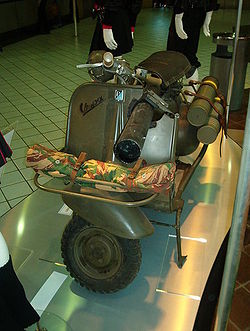
The Vespa has evolved from a single model motor scooter manufactured in 1946 by Piaggio & Co. S.p.A. of Pontedera, Italy—to a full line of scooters and one of seven companies today owned by Piaggio—now Europe's largest manufacturer of two-wheeled vehicles and the world's fourth largest motorcycle manufacturer by unit sales.
From their inception, Vespa scooters have been known for their painted, pressed steel unibody which combines a complete cowling for the engine (enclosing the engine mechanism and concealing dirt or grease), a flat floorboard (providing foot protection), and a prominent front fairing (providing wind protection) into a structural unit.
The Vespa was the first globally successful scooter.
History
Post World War II Italy, in light of its agreement to cessation of war activities with the Allies, had its aircraft industry severely restricted in both capability and capacity.
Piaggio emerged from the conflict with its Pontedera fighter plane plant completely demolished by bombing. Italy's crippled economy and the disastrous state of the roads did not assist in the re-development of the automobile markets. Enrico Piaggio, the son of Piaggio's founder Rinaldo Piaggio, decided to leave the aeronautical field in order to address Italy's urgent need for a modern and affordable mode of transportation for the masses.
Product
On 23 April 1946, at 12 o'clock in the central office for inventions, models and makes of the Ministry of Industry and Commerce in Florence, Piaggio e C. S.p.A. took out a patent for a "motorcycle of a rational complexity of organs and elements combined with a frame with mudguards and a casing covering the whole mechanical part".
The basic patented design allowed a series of features to be deployed on the spar-frame which would later allow quick development of new models. The original Vespa featured a rear pillion seat for a passenger, or optionally a storage compartment. The original front protection "shield" was a flat piece of aero metal; later this developed in to a twin skin to allow additional storage behind the front shield, similar to the glove compartment in a car. The fuel cap was located underneath the (hinged) seat, which saved the cost of an additional lock on the fuel cap or need for additional metal work on the smooth skin.
 The scooter had rigid rear suspension and small 8-inch (200 mm) wheels that allowed a compact design and plenty of room for the rider's legs. The Vespa's enclosed, horizontally-mounted two-stroke 98 cc engine acted directly on the rear drive wheel through a three-speed transmission. The twistgrip-controlled gear change involved a system of rods. The early engine had no cooling, but fan blades were soon attached to the flywheel (otherwise known as the magneto, which houses the points and generates electricity for the bike and for the engine's spark) to push air over the cylinder's cooling fins. The modern Vespa engine is still cooled this way. The mixture of two-stroke oil in the fuel produced high amounts of smoke, and the engine made a high buzzing sound like a wasp.
by, wikipedia

No comments:
Post a Comment